

Home  Torah Lamplighter Torah Lamplighter |
Volume 28 Issue 17
May 31-June 6, 2026 - 15-21 Sivan, 5786
Torah Reading: Behaalosecha
Candle Lighting: 8:08 PM
Shabbos Ends: 9:07 PM
Parsha Synopsis · A Word From the Rabbi
Essay · Thoughts That Count
Once Upon A Chassid · Tid Bits · Happenings · Notes From Israel
Parsha Synopsis
Behaalosecha
Numbers 8:1–12:16

The name of the Parshah, "Behaalotecha," means "When you raise" and it is found in Numbers 8:2.
Aaron is commanded to raise light in the lamps of the menorah, and the tribe of Levi is initiated into the service in the Sanctuary.
A “ Second Passover” is instituted in response to the petition “ Why should we be deprived?” by a group of Jews who were unable to bring the Passover offering in its appointed time because they were ritually impure. G‑d instructs Moses on the procedures for Israel’s journeys and encampments in the desert, and the people journey in formation from Mount Sinai, where they had been camped for nearly a year.
The people are dissatisfied with their “bread from heaven” ( the manna), and demand that Moses supply them with meat. Moses appoints 70 elders, to whom he imparts of his spirit, to assist him in the burden of governing the people. Miriam speaks negatively of Moses, and is punished with leprosy; Moses prays for her healing, and the entire community waits seven days for her recovery.
.


Amongst the varied items for which we seek forgiveness in the confession prayer recited on the holy Yom Kippur, is a somewhat odd class of transgression: “The sins which we have committed before You with the ‘Yetzer hara,’ (evil inclination).”
“But,” as my early days spiritual mentor would rhetorically muse, “Aren’t all sins preformed with the evil inclination? Surely there are no sins committed with the ‘Good inclination?’
“The sins which we have committed with the evil inclination,” he would offer as a rejoinder, “Refers not to sins which the evil inclination had managed to drag us into, but rather to sins into which we had managed to drag our evil inclination.”
Sometimes the Yetzer Hara lies dormant; not interested in us, yet we go ahead and agitate it: “Nu, what’s the matter with you? Wouldn’t this or that indulgence be pleasurable? Come on get to work!”
- - - - - - - - - - - - - - - - - - - - - - - - - - - - - - - - - - - - - -
If someone were to tell you that tens of thousands of grown adults had taken to the streets, weeping bitterly over their sad state of “Beef deprivation,” you would likely treat it like a joke. You might check your (spiffy electronic) calendar to make sure it’s not April 1st.
Yet this strange scenario is not in the least a hypothetical construct or in any way flippant. The Amalgamated Meat-Deprived Victims was a real phenomenon. The subjects of this bizarre and unruly occurrence were our very own ancestors.
It happened soon after their liberation from Egyptian bondage, at the very outset of their journey through the desert towards the Promised Land when things went bad: “The rabble that was among them cultivated a craving,” states this week’s Parsha, Beha'aloscha, “And the Children of Israel also wept and said, ‘Who will feed us meat?’”(Numbers 11:4).
The self pity of the beef deprived victims is as baffling as it is amusing, for after all, since when do adults weep over missed beef, even if they haven’t had a good steak in a long time and crave it very badly? The bafflement of this week’s Torah narrative, however, extends well beyond the brow-raising beef crisis. The broader Parsha narrative, it appears, is no less riddled with enigma and inconsistencies.
The state in which the Israelites are portrayed in our Parsha can best be described as “Upheaval.” In fact, so defiant are the Israelites reported to have become that they are found romanticizing over their good-old-days – savoring, of all things, their brutal Egyptian bondage – even as they bitterly lament their new impoverished diet and boring fare: “And thus the men complained, we remember the fish that we would eat in Egypt free of charge; and the cucumbers, melons, leeks, onions, and garlic. But now our life is parched, there is nothing; we have nothing to anticipate but the manna!” (Numbers 11:5-6).
This narrative appears to trigger a slew of perplexities. The claim about the “Free fish,” for example, seems entirely ludicrous as noted in the Talmud: “Since when was anything free in the land of slavery muses the Talmud. Even straw for bricks was not provided for them, how could they have possibly convinced themselves that they had free fish?”
Furthermore, what could they possibly have against the manna that faithfully rained down from heaven, day after day, in order to satiate and sustain them?
The manna, we are taught, not only provided necessary nutrition, it furthermore had the miraculous ability to transform into a palette of delicacies upon the mere whim of its consumer. How could anyone mock that?
Even more perplexing is Moshe’s reaction to all this. Whereas in other instances, which appear to have been far graver, such as the sin of the golden calf, he goes to bat on behalf of the Children of Israel, even at great risk to his own relationship with G‑d, yet here he tends to lose his patience with them. Instead of defending them he appears to give up on them.
Most curious of all, though, is why the Torah would include this embarrassing episode as part of its narrative. The Torah is surely not in the habit of repeating Lashon Horah. Why is it important for us to know about the Israelites’ shameful and unbecoming conduct?
The answer is because therein lie pertinent psychological and sociological lessons for all of Israel and mankind for all of time. Indeed, critical Insights regarding the delicate and elusive nature of true contentment and meaningful fulfillment are contained herein.
The Talmud asserts that when the Israelites romanticized about the “Free” food that they enjoyed in the land of Egypt, they were actually alluding to something entirely different. They were lamenting the fact that in Egypt their food was entirely free from Divine commandments-Mitzvos, while now they were confined and restricted by G‑dly rules and commands.
Rashi makes a similar assertion. In reference to the verse that states “Moshe heard the people weeping in their ‘Family’ groups.” Says Rashi: The issue of “Family” signifies the underlining reason for their complaints: “They were frustrated by family laws, i.e. non permissible sensual relations and adultery.”
So, while they spoke about fish and leeks and onions and garlic, their true frustration had nothing at all to do with that. While they may have convinced themselves that they missed the food that they never really ate in Egypt, something entirely different was actually going on.
Accordingly, the first lesson to be gleaned from the shameful events related in our Parsha is the identification of a novel human trait that precipitates inner-conflict, discontentment and rebellion.
The source of this destructive trait appears to be a distorted sense of reality. It is the product of an unhealthy emphasis and perverted recollection of one’s past, or the unrealistic expectations and exaggerated focus on the future.
The one thing that seems apparent about this debilitating syndrome is that it is not the result of any real or legitimate need. It is rather the consequence of an arbitrary and capricious wishfulness – wanting for the sake of wanting or just because it’s there, or at least we believe it’s there.
First it’s yesterday’s imaginary fish; then it’s the aroma of tomorrow’s irresistible meet, which in truth is none of the above but rather disguised devious desires.
This malady is arguably the result of a life too good and tranquil – a wistful dullness that is born out of not having any true wants or worries – not having enough Tzores (Heaven forbid) to contrast our abundant blessings.
This peculiar character trait, it appears, has yet to be explicitly identified in modern psychology. Even within Judaism it appears somewhat deficient of decisive definition.
The only direct Biblical mention of this phenomenon is in our Parsha. The unique word the Torah uses to describe the particular syndrome is “Misoninim.” It is the only time this word is found in the Torah. Yet the discontentment and disgruntlement that stems from the Misoninim affliction serves as a sure breeding ground for untold strife and upheaval.
There can be no better proof of this fact than Israel’s precipitous slide, beginning with their extraordinary self transformation, the most significant in human history – consummated by the historic Divine encounter at Mount Sinai – and ending with their tragic condemnation to the desert’s soil. This noteworthy phenomenon is further exacerbated by the fact that at the time of their tragic inversion things could not have been looking any better for them as a people.
Having just attained new majesty by virtue of their glorious national formation and tribal order, they have realized the pinnacle of nationhood. Encamped as they were around the Holy Sanctuary – each tribe proudly boasting a distinctive banner and flag – the conquest of the Promised Land was in clear view.
Indeed, with an army in place, Kohanim prepared to serve and Levites filled with song, they seemed perfectly poised for redemption. But then, as if out of nowhere, began the downward spiral; the swift deterioration that resulted in the condemnation of the entire generation that left Egypt.
They had only begun their remarkable career away from the abyss of Egypt into the spiritual crucible of the wilderness, where they accepted the privilege of Divine service and way of life, and they have already regressed. What happened and why?
It all began in “Chapter eleven” (pun intended) of our Parsha: “And the people took to seeking complaints.” It is fascinating that the Torah in this episode makes no attempt to ascribe any cause or reason for their complaints.
The Torah appears hereby to introduce the aforementioned destructive human characteristic. Some complaints are triggered by rational causes, though not necessarily legitimate, but others have no rational cause – Kvetching for the sake of Kvetching. The complainer is himself not sure as to why he’s complaining.
An amazing insight into the human psyche is herein contained: Just because we have it all doesn’t mean we have achieved happiness. No matter how good things may be it is human nature to get tired and seek something new and different – to get bored and complain.
When they left Egypt, the Jewish people had it all. At Mount Sinai they were inspired and invigorated as they declared: “We shall do and we shall hear!” They had great hope and great excitement. They had purpose and they had mission. But they lost direction. They were stricken by the Misoninim Syndrome and allowed themselves to lose it all.
The important lesson contained in this narrative is that Happiness and contentment are a skill unto themselves. They are not the result of the things we have but rather the things we learn. They are traits that must be developed and cultivated.
Our Parsha teaches us that to have it all is not necessarily to have it right. To have it right we must know how to hold on to the blessings and remain inspired. We must learn to derive inspiration from truth rather than from novelty and pleasure. We must likewise learn to live in the present rather than the past or future.
May we take to heart these poignant lessons of our Parsha and apply them well. By learning how to avoid falling prey to the “Kvetching Syndrome,” we will surely remain focused on our cosmic mission, which began with our birth as a nation upon our exodus from Egypt, and hasten thereby the era of Moshiach BBA .
Gut Shabbos!
Rabbi Kahanov is the founder/director of Chabad in Northeast FL, consisting of 6 Chabad Centers
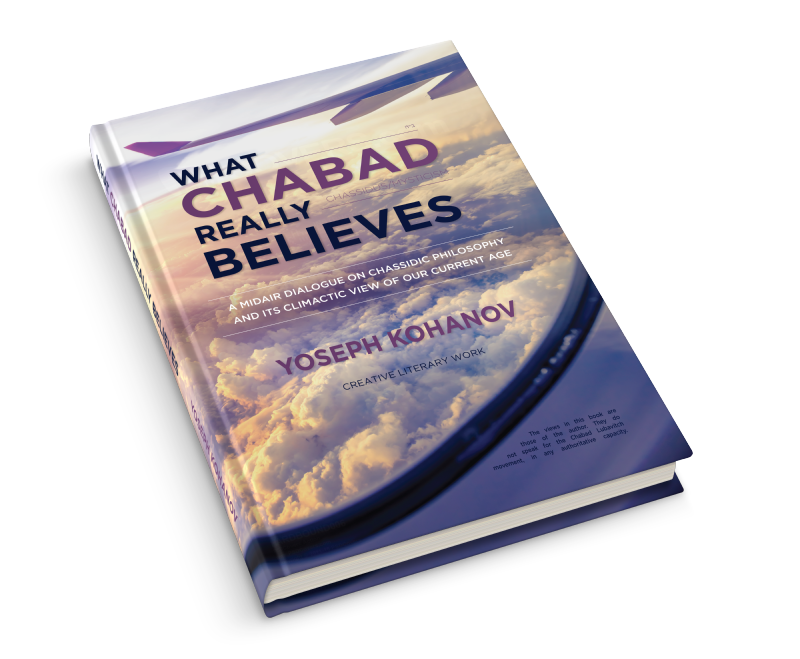
He is also the author of "What Chabad Really Believes"
If you like this, you might be interested in purchasing his book click here for more information
Spiritual Pyromania
Yehudah Avner, who served on the staff of five Israeli prime ministers, once asked the Rebbe, "As a Jewish leader, what are your ambitions?"
"Yehudah," said the Rebbe, "what we call a candle is merely a piece of wax with a string down the middle. When does it really become a candle? When a flame ignites the string." The Rebbe continued: "The wax is the body of a human being, and the wick is the soul. When the flame of Divine wisdom ignites the soul, the person becomes complete. That is what I try to do—to ignite souls."
At the end of the meeting, Mr. Avner quipped: "So, has the Rebbe lit my candle?"
"No," answered the Rebbe with a smile, "But I have given you the match…"
A Lasting Flame
Have you ever seen a soul?
Does anyone even know how one looks, if it does at all?
King Solomon may have been the first to ascribe imagery to the soul, when he poetically waxed it a candle.
"The candle of G‑d is the soul of man," he said.
This metaphor fired up the mystics' imaginations, and it led Rabbi Schneur Zalman of Liadi to connect the sparks with his suggestion that the seven-branched candelabra in the Holy Temple was but a physical manifestation of a spiritual source of light, made of seven different types of souls.
Aaron, then, who lit the Menorah, represents one who lights souls.
G‑d said to Moses, "Speak to Aaron and say to him: 'When you kindle [beha'alotcha] the lamps…'"
The word beha'alotcha is understood to mean "kindle." Literally translated, though, it means "raise." Aaron was meant to "raise the lamps."
Raise the lamps? As in "keep the lamps in high places, away from children"?
Probably not.
So what does the unusual language come to teach?
An illuminating message:
If the verse were to use the word "kindle," Aaron's obligation would consist only of bringing fire to wick. If the fire then petered out, so be it. After all, the flame had been kindled, according to G‑d's command.
The word "raise," however, obliges Aaron to "hold a fire to the wick until the flame rises by itself." Aaron was commanded to light the lamp in a way that ensured it would remain lit.
The word "kindle" refers to the act of lighting; the word "raise" tells us about its purpose: that the flames become self-sufficient.
Technically, the Torah's concern here is about the longevity of the lamps and souls we light; mystically, the Torah's concern relates to their character and quality: that they develop enough passion to burn on their own.
We can inspire them, or teach them to inspire themselves. We can be their wings, or teach them to fly.
What's in It for Me?
The Rebbe was once discussing with a chassid the progress of a mutual acquaintance who was on his path towards Jewish observance. The chassid suggested that the Rebbe recommend to this person that he begin to grow a beard as his next step upwards.
"Coming from you," the chassid said, "there is no doubt that he will take it upon himself, if for no other reason than to please the Rebbe..."
"But if he agreed," replied the Rebbe, "he'd be wearing my beard, not his own."
As they say: Give a man a fish, and you have fed him for today. Teach a man to fish, and you have fed him for a lifetime.
(Parenthetically: Teach a man to sell fish, and he eats steak.)
When lamp-lighting, educating, parenting, or just giving advice, the point is to bring others to realize their own potential.
This is especially true regarding the education of children.
A teacher's role is not just to transmit knowledge or data, but to give students the tools with which to learn on their own.
And the greatest gift a teacher can give his or her student, more important even than tools for learning, is a love for learning.
For children can be kindled or raised.
On a similar vein, Maimonides teaches that lending money is greater than giving charity.
But isn't that illogical? The lender gets his money back while the charity-giver doesn't!
Maimonides, however, is not discussing the provider, but the recipient. From his perspective, lending keeps him on his feet; begging keeps him off of them.
In sum:
To help someone is to put them on their feet—not on your shoulders.
Based on the Rebbe's teachings, published in Likutei Sichot vol. 2, pg. 314-320.
Rabbi Mendel Kalmenson is the rabbi of Beit Baruch and executive director of Chabad of Belgravia, London, where he lives with his wife, Chana, and children. Mendel was an editor at the Judaism Website—Chabad.org, and is also the author of the popular books Seeds of Wisdom, A Time to Heal, Positivity Bias, and On Purpose.
When you light the lamps, then shall the seven lamps give light toward the body of the candlestick (Num. 8:2)
The seven branches of the menora are symbolic of the seven branches of secular wisdom; the body of the menora is symbolic of the G‑dly wisdom of Torah. All knowledge of the natural, physical world should be used to "give light toward the body of the candlestick" - enhance our understanding of Torah - thereby enabling secular wisdom to truly illuminate. (Melechet Machshevet)
And if they blow with but one [trumpet], then shall the princes assemble themselves to you (Num. 10:4)
If genuine Jewish unity is the goal, "then shall the princes assemble themselves" - there must first be true unity among our leaders, who must cease infighting and provide a proper example for others. Only then can they demand unity from the rest of the people. (Olelot Efraim)
For G‑d has spoken good upon Israel (Num. 10:29)
The words "spoken good" occur only twice in our Scriptures, here and in Megilat Esther, where we find the phrase "spoken good for the king." According to our commentators this is an allusion to G‑d: When a person speaks well of his fellow Jew, it is considered as if he spoke well of the Master of the world. (Igra D'Kala)
Hey...
From where should I have meat to give to this entire nation…? (11:13)
Moses was unable to lower himself to the task of providing Israel with meat; his soul was far too lofty to deal with so mundane a need.
- Rabbi Sholom DovBer of Lubavitch
The surging crowd pressed close to the table at which Rabbi Sholom DovBer of Lubavitch was seated. It was Simchat Torah of 1919, the Rebbe was farbrenging, and everyone wished to hear the Rebbe's words. Soon the table, no longer able to bear the mounting pressure, collapsed.
Not wishing to disturb the Rebbe's talk, the chassidim carefully lifted the splintered table piece by piece, and passed it hand over hand out of the room. Only when he concluded his talk did the Rebbe notice what had happened and exclaimed in surprise: "Where is the table?"
"I will tell you a story" he said. "Rabbi Levi Yitzchok of Barditchov had concluded his study of shechitah and was preparing to slaughter his first hen. He took the bird in his left hand, and diligently prepared it for the shechting. In his right he held the chalef (slaughtering knife). With great concentration and ecstasy, he recited the blessing over the mitzvah which he was privileged to observe for the very first time. In the meantime, the hen decided that, under the circumstances, it was high time she ran for her life…
"The Barditchover concluded the blessing and exclaimed (the Rebbe quoted in Polish-accented Yiddish): 'Vi is di hin? Where is the hen…?' "
Tid Bits
(back to top)
17 Jewish Teachings About Money That Will Change Your Life

Money is what makes the world go round, and the Torah is full of meaningful guidance on how to earn, view, and spend it properly. Read on for 17 Jewish teachings about money and wealth. 1. “If you eat the labor of your hands, you are fortunate and it is good for you” (Psalms 128:2) Working hard to make a living is a virtue. Many of the great Talmudic sages were engaged in professions such as drawing water and carrying packages. Living in the lap of luxury might seem like the perfect life, but it’s not the Torah ideal. 2. “Want to ‘salt’ your money? Decrease it” (Ketubot 66b) It’s the paradox of financial security: Want to protect your money? Decrease it by giving charity. Charity might look like a loss on paper, but it’s your best insurance policy. Charity does more than preserve your numbers—it raises them. The Hebrew words for “tithe” and “wealth” are similar, leading to the Talmudic saying, “Aser bishvil she’tis’asher”—tithe so that you will acquire wealth. 3. “Who is wealthy? He who is happy with his lot” (Ethics of the Fathers 4:1) The key to happiness is not wealth; it is being satisfied with what you have. There is so much in life to be grateful for. Focus on what you have, not on what you don’t, and you are well on the way to happiness and true peace of mind. 4. “Rabbi Yehuda the Prince would respect the wealthy” (Eruvin 86a) G‑d picks His customers wisely. If He granted you wealth, that means He trusts you to use it well. Rabbi Yehuda the Prince would respect the wealthy—not to gain favor, but because he recognized their Divine potential. 5. “Remember the L-rd your G‑d, for He is the one Who empowers you to make money” (Deuteronomy 8:18) This might be the most foundational teaching on this list: When you succeed, don’t let it get to your head. It’s not your careful decisions and clever manipulation that brought you to where you are. Everything you have is from G‑d, so remain humble and thankful. 6. “One handful of gratification is better than two fistfuls of hard work and anxiety” (Ecclesiastes 4:6) Making less money without aggravation might be better than making a fortune without being able to sleep at night. You’ll end up with enough to buy whatever you want, but no peace of mind to enjoy it. 7. “A person prefers a portion of their own over nine portions of another” (Bava Metzia 38a) G‑d wired us with a unique nature: we appreciate the little we earn ourselves more than the plenty handed to us by someone else. Even if you end up with more, when it’s not yours, an uneasy feeling lingers. 8. “He who loves money will never be satiated with money” (Ecclesiastes 5:9) Money is a bottomless pit: the more of it you get, the more you want. It’s like a thirsty person trying to quench his thirst with salt water.3 The only way out of this vicious cycle is to stay focused on what really matters in life: G‑d, Torah, family, and giving to others. 9. “For the righteous, their assets are more precious than their own body” (Sotah 12a) This one seems counterintuitive. Why would a righteous person hold material possessions so dear? The Talmud explains: “Because they don’t engage in theft.” If money comes easily through dishonest means, it loses value, and you’re more inclined to waste it. But if you’re honest to a fault, every penny is precious. 10. “When you are brought to the Heavenly Court, the first question they ask you is: Did you make an honest living?” (Shabbat 31a) That tells you something. Before they ask whether you studied Torah, raised a family, or awaited Moshiach, they ask about your integrity in business. 11. “Making a living today is manna from Heaven” (Rabbi Shmuel Schneersohn of Lubavitch) At the end of day, making a living is nothing short of a miracle. With today’s competitive marketplace and high cost of living, simply putting food on the table is a heavenly gift. And just like the Jews in the desert, you can rely on G‑d to keep giving it. 12. “He Who gives life gives sustenance” (based on Taanit 8b) When times are tough, remember this: you didn’t get here on your own. G‑d is the one who gave you life. And that same G‑d can be counted on to give you everything you need. As we say in the Grace After Meals, “He sustains the entire world with His goodness, with grace, kindness, and compassion.” 13. “The more you own, the more you worry” (Ethics of the Fathers 2:7) Sure, it’s nice to have a fancy car, a large house with all the latest gadgets, and everything else the 21st century has to offer. But everything comes with a price—and not just the credit card type. And hiring someone to do the worrying just adds another headache to the list! 14. “Money Is Mud” (Yiddish saying) The numeric value of געלט, the Yiddish word for money, is the same as בלאטע, mud. That’s a colorful way of conveying an important message: If you aren’t careful, money can easily get to your head, harming your dignity and dirtying your character. As the chassid Rabbi Meir Simcha Chein put it, “Three things are guaranteed to affect you. Money makes you crazy, alcohol makes you drunk, and Chassidic teachings make you a better person. And if any of them didn’t affect you, it’s because you didn’t have enough of it!” 15. “Skin a carcass in the marketplace for pay, and don’t say, ‘It is beneath my dignity’” (Pesachim 113a) There is nothing more dignified than doing whatever it takes to support those you love. 16. “People worry about a loss of money (ibud damav), yet they don’t worry about a loss of days (ibud yamav)” (ancient Jewish proverb) Every moment in life has a Divine purpose. A financial loss can be recovered, but a moment that wasn’t used for its Divine purpose is gone forever. 17. “Your friend’s money should be as precious to you as your own” (Ethics of the Fathers 2:12) The Torah teaches us to “love your fellow as you love yourself.” But the Torah adds the possessive letter lamed before “your fellow.” So the verse is also telling us to cherish that which belongs to your fellow as you cherish that which is your own. A little sensitivity can go a long way toward making this world a more peaceful place. By Yehuda Altein Rabbi Yehuda Altein is a professional writer, translator, and editor with a private practice specializing in Jewish subjects and handwritten family material. He lives in Brooklyn, N.Y., with his family and enjoys exploring genealogy, antique Judaica, and natural history. He can be reached at [email protected] or 347-423-5734. |
|
If you, or someone you know, would like to receive the Lamplighter by E-mail – let us know! To add a name to the growing list of recipients please contact Chabad To sponsor an issue of the Lamplighter please contact the Chabad office. What do you think? We want to hear your comments and suggestions for the Lamplighter. Please let us know what you think! Phone: 262-6641 | E-mail: [email protected] Be A Part of It! |